Tuesday, November 14, 2017

The West Marches

Continuing from my megadungeon post, I wanted to talk about West Marches.

The West Marches

The West Marches is an old school game type, and one very similar to megadungeons in some ways.

Unlike the megadungeon, it is a hexcrawl. Hexcrawls warrant a post of their own, but I'll give you a quick overview.

Hexcrawls are named such because you're traveling across an overworld map divided into hexes:
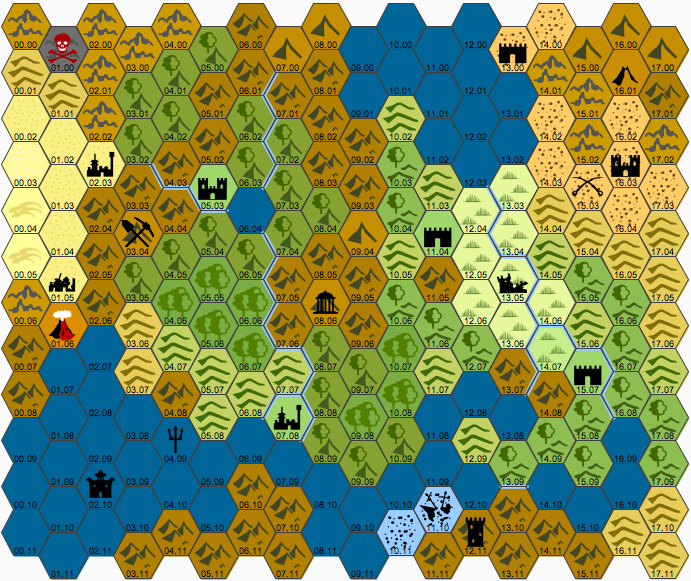


Each hex represents a region, along with any points of interest inside. The hex has its own geography, which plays a role in how the PCs interact with it. A desert? You have to deal with the blinding hot sun and heat, sand for miles on end. A forest? You have to navigate through all of threes and whatever beasts may lurk within them. Some may be quicker to travel through than others, so the route matters. Usually it takes a day or so to move into each hex.

The game is about exploration, peeling back the layers of the unknown and plundering what treasure and glory you can from the savage wilderness. The travel adds a separate layer to the game: suddenly things like how much you can carry, what you can eat, the weather, the environment and so forth, matter.

A hexcrawl is the ultimate sandbox game because there is no plot, just whatever emerges from your exploration. You choose a point on the map and strive to reach it, or explore a region for the surprise of discovering hidden locations. Plot emerges based on the interactions you have. For instance, you might discover a hidden temple of snake cultists, who are harassing a different region to gain tribute to their evil god. By defeating them, you open up a new region, or change the complexion of the surrounding areas. A nearby town might become friendly after you solved their snake problem. Everything is connected.

The West Marches is a subset of a hexcrawl entirely situated around the starting point of a city that serves as the "home base." It is the one point of civilization in the wilderness, from which all PCs emerge, and it is designed around the same style of pick up and play, drop-and-go rotating player bases.

Every session can sport a different group of players adventuring out into different regions, and when the session is over, the PCs return to town and experience downtime activities. When the next group of PCs moves out in the next session, it's understood the other PCs are just in town.

This means that just like the megadungeon, different adventuring parties of PCs can affect the game world for the other players. If KT's party loots a temple, then that temple is already cleared out if Aekenon gets there.

A lot of the fun of West Marches is in the implicit setting hidden in the territory; at first, there is no information, but the more you explore, the more you uncover. Some players love to keep maps of their explorations too, since the GM often hides the true world map to maintain that fog of war.

This kind of game tends to be rather challenging and dangerous, as PCs come and go. It plays into all of D&D's original core strengths: exploration, the escalation of powering up from nothing, gaining experience, loot, and so forth. Aside from that, any special plot is what the PCs bring into it, and they're pretty much interchangeable.

Because any group of PCs can come and go, it makes scheduling easier, and often player centric. The GM just has to be on standby, and when a party of players agree together that they want to basically go on a raid together, they just tell the GM and then the GM sets something up.

Naturally, games like this involve parties with different levels of players, since they can form their own groups. There is no thought given to keeping everyone on the same power level or making sure everyone gets a magic item or has a narrative scene or anything like that. The game is all about the open ended agency of the players and weighing the balance of adventure against how hard they want to push themselves.

One of the fun things about a game like this is seeing your PC put a tangible change into the game world. Defeating certain enemies or clearing our regions or meeting certain goals can have effects on the world maps and the various cities, like a game of Civilization. Sometimes you might have timeskips after a certain act was completed, showcasing a new era where the previous PCs actions essentially led to a new map.

It's also the type of game that basically never ends, so some groups of players literally get decades of IRL play out of their hexmaps.

So as you can see, it is similar to megadungeons in that it contains factions, the free association of players, and open endedness, but the fact that it takes place over a sprawling world map means a much broader explorative experience rather drilling down into a dungeon.

Oh, and it's called The West Marches, because the first guy to do this made a game where the home city was on the east side of the map representing the edge of civilization, with the entire westward region being nothing but wilderness.

If you google "D&D west marches" you'll find tons of people playing such games.

Megadungeons

As promised to Aekenon, here's my MEGADUNGEON INFODUMP!

The megadungeon

You stand at the foot of the cave entrance. This is just going to be another standard dungeon, right? A goblin hideaway with an ogre thrown in for good measure at the end.

Wrong. This isn't your average dungeon. It's something completely different; a megadungeon. Allow me to take you on a journey into the mythic underworld, a subterranean world-in-a-world whose twisted laws reign supreme and reality recedes like a low tide.

Welcome to the idea of a dungeon as a world setting. A dungeon so large, so deep, filled with so much material to discover, that it can support an entire campaign.

A gargantuan sprawling enterprise that is large enough to house its own factions and even civilizations, that is alive and changes as you explore it. It offers the thrill of exploring the unknown, encountering mysterious alien entities, and hauling out ancient treasures forgotten to history.

Note that the megadungeon doesn't need to be an actual "dungeon": it could be a gigantic crashed spaceship, a tower, a giant tree, a valley, etc. The key is that whatever it is should be large enough to essentially be its own world, and that going inside is leaving behind the rules of the world beyond and crossing over into a sort of fae realm with its own alien logic.

An ancient world

This isn't a new concept, but one of the ways D&D used to be played originally. There's even a clue written in the third page of the Original D&D book, Men & Magic:
At least one referee and from four to fifty players can be handled in any single campaign, but the referee to player ratio should be about 1:20 or thereabouts.
When I first heard about this, I conjured up wild images of con games run with one GM at a table of 50 players, broken up into subdivisions complete with team captains and assistant GMs. After all, if I can run a table of 8-15 players by myself, then 20 or more isn't a stretch with some help.

And indeed, there were games that were handled this way. But that isn't what this passage is alluding to.

It says a campaign can handle 20+ players. But it doesn't say that they should all be handled at once. The modern assumption is to assume that it does, because in today's D&D landscape, a campaign and its players are inseparable from each other. If you have a campaign with four players, it is assumed that all four will be present.

However, this is a callback to a different time when players would rotate from game to game, and GM to GM, in a kind of "open table" format. The GM would run the setting, but the party that shows up each game night might be different from the last one.

In a game dependent on a heavy character narrative, this would be impossible. But it is a style of play that the megadungeon suits perfectly.

Imagine a game where there is a megadungeon, with a "dungeon town" outside of it to equip adventurers and serve as a resting spot. Whoever shows up for any one session can be said to be part of the expedition preparing to enter the megadungeon, and at the end of the session they return to town to rest. Any players who are not present could be said to be in town at the time pursuing other business. It's perfect! (It's possible to play a megadungeon with a conventional arrangement of one recurring group, of course, but what makes a megadungeon special is its ability to support this alternate playstyle.)

A megadungeon is the perfect setup for an open table game with a huge community of players. There is no long term commitment; no wrestling with schedules. Whoever can show up to play shows up. You can have recurring players, or first time ones; it doesn't matter. Rather than a continuity with the group, there is a continuity with the world.

This opens up the possibility for interesting interactions not only between a player group and the megadungeon, but between different player groups. A door that is smashed by Aekenon in one group will still be smashed when Lavarinth finds it in a second group. If Fallen releases a monster from its prison while he's down there, it'll be prowling around when Kameko arrives. When Milldawg defeats a boss, the consequences will be seen by those who follow. They'll all be playing in the same world.

It's a living world that changes between each foray into it. This is true of all RPGs, but especially of megadungeons, which will constantly be under the influence of the different players traveling through it and the NPCs living it.

Delve as deep as you dare

Such an open and exploratory game demands a different structure than is typical. Rather than awarding experience from reaching a plot milestone, or defeating monsters, the players earn experience by bringing gold back to town and spending it. This puts the focus on exploration: the goal is to delve as deep as you dare in the search of treasures, and because gold grants you experience, you're pushed to keep on exploring until you can find the next jackpot.

This enables a much freer mode of gameplay: rather than needing to defeat a monster to get experience, you can deal with them in any way you want. In fact, combat can often be a hindrance as it'll uselessly deplete resources, unless it serves some greater purpose. It may be more effective to negotiate with an Ogre to get some of its treasures than to simply slay it. Perhaps the Ogre would be happy to give you some of its gold hoard if you slay a group of orcs that have been pestering it across the river.

It also provides a self-balancing mechanism. Rather than the GM being forced to do the impossible feat of tailoring encounters to an ever-changing group of players who will have free range to engage an unpredictable set of enemies, it will be up to the players themselves to decide how much they want to tackle in their search for treasure. Does the party decide to settle for what it has, and head back up to town? Or do they decide to keep pushing ahead, injuries and all? The more danger you take on, the greater the potential rewards.

The fact that no experience is awarded until the party returns to towns and spends it facilitates the "in and out" nature of the sessions, as well as downtime activities. It gives gold an inherent value. It all fits!

Twisting, turning, through the never

Don't think that this means that this is just a boring old "hack and slash" dungeon crawl, though! On the contrary: you have a place big enough to be its own world-in-a-world, which means it's big enough to host a variety of landscapes and groups in it: an underground meadow, a subterranean sea, a volcanic lair, a mushroom forest, etc. When you combine it with the magical surrealness that suffuses the megadungeon, you have the recipe for an endless array of interesting locations.

And those locations will have creatures in them! Creatures that have moved in to live there; creatures that are adventuring in the area, just like you; creatures that have mysteriously always existed; creatures that crawled up from the foreboding darkness below. Often times they will be at odds with each other, giving the chance for politics and roleplaying.

Perhaps some bandits on the upper layer of the megadungeon are being troubled by a faction of dark elves below. If you help the bandits, they may help equip and supply you in the dungeon, but grow more dangerous to passerbys in the surface. If you help the dark elves, they may wipe out the bandits and begin to control the resources the bandits once did, increasing their influence in the megadungeon. And so forth.

These megadungeons are sometimes called "campaign-dungeons" because they are essentially locations where an entire campaign can play out, as opposed to an "adventure-dungeon" which is meant to be scoured once as part of a story and then left behind.

In the end, the megadungeon can provide a satisfying experience for those who invest the time in exploring its mystical depths, and easy way to join the fun for those who can't.

And I totally want to run something like that, one day...

Tuesday, April 19, 2016

Shooting into melee combat

When shooting a ranged attack into melee combat, the target gets +4 to their AC due to the difficulty of shooting through the mess of foes.

If the attack misses, then the attack will instead hit somebody who has less AC than the attack roll.

Example:

Fighter is battling a demon. The demon has an AC of 20. The Fighter has an AC of 17.

The party Ranger tries to help and shoots into the melee, targeting the demon. The demon normally has 20 AC, but for the purposes of this attack, has 24 AC. This is because the Ranger needs to take extra care to hit the right target.

The Ranger rolls their attack and gets a 21. 21 is too low to beat 24, so the attack misses the demon. However, because 21 is higher than the Fighter's AC of 17, it hits the Fighter instead.

If it's lower than the Fighter's AC as well, then the attack misses and hits nobody.

Tuesday, February 16, 2016

LMOP: Same Page Tool

For my offline Phandalin game, this is a tool to clear up assumptions and get everybody on the same page about what kind of game we're expected to play. The point is to create a clear ideal for playstyle, not try to mash together 50 different competing styles.

The selected answer is in red.

1) Do you play to win?
a) Yes, you totally play to win! The win conditions are…
b) Good play isn’t a win/lose kind of thing

2) Player characters are:
a) expected to work together; conflicts between them are mostly for show
b) expected to work together; major conflicts might erupt but you’ll patch them up given some time
c) expected to work together; major conflicts might erupt and never see reconciliationd) pursuing their own agendas – they might work together, they might work against each other
d) pursuing their own agendas – they might work together, they might work against each other
e) expected to work against each other, alliances are temporary at beste) expected to work against each other, alliances are temporary at best

3) The GM’s role is:
a) The GM preps a set of events – linear or branching; players run their characters through these events. The GM gives hints to provide direction.
b) The GM preps a map with NPCs and/or monsters. The players have their characters travel anywhere they can reach on the map, according to their own goals.
c) The GM has no plan – the GM simply plays the NPCs and has them act or react based on their motivations
d) There’s no GM. Everyone works together to make the story through freeform.
e) There’s no GM. The rules and the system coordinate it all.

4) The players’ roles are…
a) …to follow the GM’s lead to fit the story
b) …to set goals for their characters, and pursue them proactively
c) …to fling their characters into tough situations and make hard, sometimes, unwise choices

5) Doing the smartest thing for your character’s survival…
a) …is what a good player does.
b) …sometimes isn’t as important as other choices
c) …isn’t even a concern or focus for this game.

6) The GM’s role to the rules is…
a) …follow them, come what may. (including following house rules)
b) …ignore them when they conflict with what would be good for the story
c) …ignore them when they conflict with what “should” happen, based either on realism, the setting, or the genre

7) After many sessions of play, during one session, a player decides to have her character side with an enemy. This is…
a) …something that shouldn’t even happen. This is someone being a jerk.
b) …where the character becomes an NPC, right away or fairly soon.c) …something the player and the GM should have set up ahead of time.
d) …only going to last until the other player characters find out and do something about it.
e) …a meaningful moment, powerful and an example of excellent play.

8) A fistfight breaks out in a bar! The details of where everything is – tables, chairs, where everyone is standing is something that…
a) …is important and will be displayed on a map or grid, perhaps using miniature figures.
b) …is something the GM will describe and you should ask questions to get more information.
c) …you can decide on the spot using specific game rules (rolling dice, spending points, whatever)
d) …isn’t really that important other than it makes for an interesting scene- pretty much anyone can come up with details.

9) In order to really have fun with this game, the rulebook is something that
a) …everyone playing needs to have read and understood before play, because the rules and setting are both very important.
b) …everyone should know the rules very well.
c) …everyone should know the setting very well.
d) …everyone at least should know the basics of the rules.
e) …everyone at least should know the genre the game pulls from
f) …Only one person needs to really know the rules

10) This game runs best when the players take time to create characters that are…
a) …built to face challenges using the mechanics and stats.
b) …written with extensive backstories or histories
c) …given strong motivations and an immediate problem or crisis
d) …tied into the other characters as (allies) (enemies) (as either)
e) …written with some knowledge, research or reading up on the game setting, real history or an actual culture


Friday, November 27, 2015

Inspiration

I've decided to experiment with using Inspiration in our current Lost Mines of Phandelver 5th edition D&D campaign. To that end, here is how I'm going to apply it in the actual game.

Using Inspiration gives you Advantage on an attack roll, saving throw, or skill check. (When you have Advantage, you roll two d20s instead of one, and keep the higher number. Likewise, Disadvantage means rolling two d20s and keeping the lower one.)

First of all, everybody will start each game with exactly one Inspiration. You can only have one Inspiration at a time, so it behooves you to use it. But you can only use it during certain times.

Taking an Inspired Action

You can use your Inspiration when you're doing something that ties into your character's personal characteristics (ideals, personality trait, bonds, flaws).

1. You can use it to give yourself Advantage.

As an example, let's suppose you have the Personality Trait, "My greataxe is a family heirloom, and it’s by far my most precious possession," and during a battle it gets knocked away, teetering on the edge of the cliff. If you put yourself in danger to try and save it, you could use Inspiration.

2. You can also use it to give Advantage to SOMEONE ELSE with their own actions.

Suppose that your Personality Trait is "I see people as marks for a con and have difficulty feeling true empathy for them," and you decide to help a fellow conman size up a potential victim. You could use your Inspiration to give them Advantage on their attempt to trick their target.

3. Lastly, you can use it to give Disadvantage to SOMEONE ELSE.

For example, if your ideal is "I must protect my friends," and you decide to help take the brunt of an assault, you could use your Inspiration to help them fend off the attack and give the enemy Disadvantage on their attack roll.

The important part is it has to connect directly to your personal characteristics somehow, and that you're actually in a position to be able to do something. You can't just toss in an Inspiration to help someone if you're not even in the same room, or help defend them from someone if you're not actually able to do so, etc.

Earning Inspiration

Once you've burned up your Inspiration, you can earn a new Inspiration point by volunteering to impose Disadvantage on your roll based on one of your personal characteristics, OR by making a decision that creates a significant setback. Either one has to be related to personal characteristics.

1. Imposing Disadvantage based on a personal characteristic

Suppose you have a Flaw, "I'm easily tempted by shiny objects," and you're asked to roll Perception in a room studded with glittering gems and treasure when you're searching for a trap. You could volunteer to impose Disadvantage on the roll because your character is too distracted by the gems to notice the obvious traps laying about.

2. Making a decision that creates a significant setback

You can also earn Inspiration back when making a decision that creates a setback. Suppose you've taken an oath to never lie, and an enemy asks you an incriminating question. You answer honestly, giving him critical information or a significant advantage.

Character Development

People change and grow over time. As your character experiences challenge and loss, triumph and adversity, they might believe in new ideals or shed previous ones. Sometimes the DM will invite you to wipe out an old characteristic and replace it with a new one that reflects the current character. For instance, if you had an Ideal, "The Church is always right," and your character goes through a harrowing experience that could cause him to lose faith, you might strike out that Ideal and replace it with something new.

This is still a work in progress, but it should give you an idea of how it works.

Monday, December 8, 2008

Understanding the stack

Whenever you play a spell or use an ability in Magic, it doesn't just happen instantly. There's a space between when you cast it, and when it actually happens, a kind of magical limbo called the stack, where your spell goes. Whenever anybody puts something on the stack, everyone has a chance to respond to that and play their own spells or abilities and put them on the stack as well. When nobody has anything to add anymore, the spells start happening, or resolving, in the order of the last spell cast to the first one. In other words, last is first. The original spell is cast, then another is put on top of it, like a building block, signifying the order. When it is time for the spells to resolve, they resolve one at a time, from top to bottom.

SPELLS

Let's suppose you're playing green and have a Llanowar Elves in play.


You have a Giant Growth in your hand.

Your opponent is playing red, and casts a Shock, targeting your Llanowar Elves. What happens now? The Shock doesn't happen instantly, in real time, at least. It goes on the stack.


Now, you have a chance to respond to it. If you do nothing, the Shock will resolve, and your Llanowar Elves will be dealt 2 damage, killing it.

But you want to save your Llanowar Elves. So you cast Giant Growth in response to Shock. What happens now? Your Giant Growth goes on the stack, above Shock.


Your opponent has no response. Since neither of you have decided to play anything else, the stack begins resolving, one at a time. The top item, the one that was played last in real time, resolves first.


Your Giant Growth resolves first, and gives your Llanowar Elves +3/+3 until end of turn. After that, the Shock resolves and deals 2 damage to the Llanowar Elves, but it survives because it is already a 4/4.

Now suppose this Llanowar Elves is attacking your opponent later into the game. You want to deal more than 1 damage, so you cast a Giant Growth targeting your Llanowar Elves before damage is dealt. (Combat damage uses the stack too, by the way.) Your Giant Growth goes on the stack. In response, your opponent casts Shock, targeting your Elf as well. The Shock goes on top of the stack, above your Giant Growth. You have no response. The stack begins to resolve, and since the Shock is on top it resolves first. It deals 2 damage to your Llanowar Elves, and it dies. Next, your Giant Growth resolves, but there is no creature left for it to pump up, so it does nothing and your attack is thwarted. You'll have to find another way to win.

COUNTERSPELLS


Counterspells work in a similar way. What a counterspell does is go on top of a spell on the stack, and resolve first. The effect of the counterspell resolving is to kill the spell it's targeting; it takes it off the stack and throws it into the graveyard. That spell never has a chance to even hit the table. What is key to understand is that they counter spells, which means they can only do their work when that spell still exists as a spell, on the stack, not as a card in your hand, or an object in play. Once that moment is gone the counter does nothing.

ABILITIES

Abilities use the stack as well. When you activate an ability, that ability goes on the stack and waits to resolve, along with other spells that may have been played before or after.

Suppose you control a Master Healer.


I'm tired of you constantly saving your creatures and hurl a Lightning Blast at your Master Healer.


My Lightning Blast goes on the stack. In response, you tap Master Healer and activate her ability, choosing your Master Healer. Her ability goes on the stack, above my spell. It resolves first; the next 4 damage that would be dealt to Master Healer this turn will be prevented. Next, my Lightning Blast resolves and deals 4 damage to Master Healer, but it is prevented. Nothing happens to her.

If we did it in the reverse order, something else would happen. If you tapped Master Healer to prevent 4 damage to herself, for whatever reason, and I cast Lightning Blast in response, my spell would go above hers on the stack and resolve first, killing her. Her ability would resolve next, but she wouldn't be there anymore to have any damage prevented to her, and it does nothing.

What I have described is called an activated ability. It is an ability that is used when you activate it by paying a certain cost. The format is, "[COST] : [EFFECT]". As long as you can pay the cost, you can play the ability. It doesn't matter when, unless it specifies it.

But there are other kinds of abilities that use the stack. There are triggered abilities, which only happen when something it is set to detect triggers it. These usually are written as, "Whenever something happens, do something."


At the beginning of your upkeep, Phyrexian Arena's ability triggers and goes on the stack. After it resolves, you lose 1 life (and draw an extra card — the POWER!). It can be responded to, as well, just like any other item on the stack. For instance, if you are at 1 and have this out, you could play a spell in response to Phyrexian Arena activating to gain some life before it resolves and makes you lose.

There are also mana abilities, which are simply abilities that produce mana. These do not use the stack and cannot be responded to. The last kind of ability are static abilities, and these do not use the stack either; they are simply characteristics of the card, like "flying," or "first strike." They are always on.

The stack is one of the confusing aspects of Magic for newer players, but as you can see, it is not as complicated as it seems. Once you grasp the fundamentals, it becomes second nature. There is another level to it with combat, but I'll save that for another day.

Tuesday, October 14, 2008

Metagaming Etiquette

As everybody knows, nobody likes a metagamer. Metagaming is considered cheap by most players. Getting called a "metagamer" is not a compliment. Note that I'm talking about casual play between friends, not tournament play. In a tournament, anything goes and nobody's going to care if you do one strategy or another; everybody is trying to win. But otherwise, creating one deck for the sole purpose of beating a specific other deck and nothing else is what's frowned upon. First of all, it's not going to be able to beat anything else. It's made solely to spoil somebody else's fun.

That, however, is its own punishment, because it does not improve your skill. Anybody can throw together a random pile of cards that's designed to beat one deck and nothing else. What improves one's abilities is forging a strategy that is able to handle the aforementioned opponent but still stand up to the rest as well. Having to make the compromises between the focus on thwarting a particular enemy strategy and maintaining general effectiveness is what creates good judgement and deckbuilding skills.

There's also no point to playing such a deck that's metagamed completely against one deck. Why? Well, if your deck is designed solely to beat mine, and it doesn't have to worry about anything else, and all the cards are picked specifically for the purpose of thwarting other cards in my deck, then of course it's going to win. But then why bother even playing? What would it prove? It doesn't prove that one player is more skilled than another, or that they have designed a better deck. It just shows that, obviously, a deck designed with cards designed to beat a certain strategy is going to beat it. If somebody was doing that with me, then I wouldn't play with them, or just use another deck. At which point their scheming will have been for nothing, or they'll switch to another deck that's metagamed for that deck, and I'll have no reason to use that one either, and so on, ad infinitum. You shouldn't be worried about losing to an unfavorable matchup. It presents a learning opportunity that will let you tune your deck better to its weaknesses.

MAINBOARDING
It doesn't matter what kind of deck you stack if you're stacking it.


Then there's the matter of maindeck design. The maindeck is designed for the general match, and the sideboard is for bringing in something specific to a certain strategy you've anticipated in the second and third game. Once again, it rewards skill, since a good player will have prepared a good sideboard and be better prepared going into the next match. If they phoned it in then their sideboard will be useless. Some players prefer not to bother with a sideboard, and just modify their maindeck before each game to suit the deck they're playing against. This makes me want to drive that player's head through the wall. Not only does that remove a critical element from the game, but it is also cheap because it basically foregoes the match of the two original decks competing against each other and replaces it with the metagamed deck designed to beat my original deck.

Generally a player who does that does it under the impression that it's helping them, but it actually isn't. Who it actually helps is the player with the bigger card collection. Instead of just limiting the help we're going to bring into the three round match to fifteen cards, we now have access to every card we own. You might swap in a few cards here or there that you've brought along to suit the person you're going to face, but now I can just as easily go through my entire collection and find just the right cards that completely annihilate your deck. And since there's no limit on what we're changing, there isn't any component of skill in it, so each player can just grab handfuls of whatever card we want and throw it in, instead of the selection being limited by the our selection of fifteen cards which require the choices to be narrowed by the our judgement.

If you're the worse player, then it only hurts you. If you're the better player, you don't need that assistance anyway because you should be skilled enough to design your deck. In either case it's unnecessary.

Also, if you know beforehand, when you're designing your maindeck, that you won't be using a sideboard but can bring in anything you want, it does not force you to make choices in how you design your deck. It doesn't really matter what you put in there because you can just change it whenever you want. You don't have to worry about having made it too set on stopping aggro decks to have game against control, because as soon as you run up against that control deck you can just swap everything out and make it into an entirely different deck. The decks themselves become meaningless. Knowing that you only have so few cards to bring in later forces you to decide beforehand what your deck is going to emphasize because it can't go after everything at once, and that it only has so much reinforcement coming in from the side later on.

Will these players ever get better by taking the easy route? No. Their skills will stagnate and they'll get left behind instead of developing themselves and their decks in adjustment to what they face off against through their play experiences, giving them a wealth of knowledge and wisdom to call upon when they need it.

Metagaming

What is metagaming? A "meta"-something is that item turned in to apply to itself. For instance, metaphilosophy is the philosophy of philosophy. Metahistory would be the history of the chronicling of history. "Metagaming," in the general context, would be using information outside the game to influence elements within the game. If you know a certain player loves to play a certain way, and you play to exploit that, then you are conducting a basic form of metagaming.

In the case of Magic, metagaming takes place within the "metagame." The metagame is the current roster of decks being played in the gaming environment. It's the field you'll be competing in. Since we all play with different groups of people, our metagames are all different. Within my group of friends, for instance, almost everybody loves to play aggressive creature based decks and so the metagame is aggro heavy. Within another group, the metagame may favor control. On the tournament scene, the metagame is a national phenomenon that is composed of the entire competitive Magic community.

Decks are defined within their metagames. There is no such thing as the "perfect" deck, that is objectively the best and that can defeat every other deck. If that was the case, everybody would play the same deck and the game would die. A deck is only good insofar as how it relates to the other decks in its field. A slower, controlling deck, for instance, could be great in an environment of other control decks but would get eaten alive in a metagame filled with super aggressive decks that have made playing such a deck unthinkable. There are objectively better decks, but the environment can make it so that such a deck still is unplayable because all of its matchups against other decks in the metagame are poor.

"Metagaming," therefore, in the Magic context would be using this information of what decks are dominant and what decks are getting destroyed to influence what you play. It is a continuum that is constantly in flux, like an ecosystem. For instance, you may notice that within your metagame a certain kind of deck is constantly played and crushes the other decks. People will eventually start playing decks that take such obstacles into account and are better suited to defeat them. Eventually, the original deck will be deposed and a new deck will reign. But then decks that the previous King of the Hill kept in check will no longer have their natural predator pushing them down, and flourish again, which will throw the metagame up in the air again.

The challenge is using this information to create a deck that is ready to handle what lays in its game environment but that isn't so focused on defeating a particular strategy that it fails against everything else, and is therefore a failure. You have to assume a general metagame where any of them could come up as opponents, and therefore your deck has to be equipped to deal with the metagame at large, rather than a specific deck. Since games are generally played in sets of three, and you have a sideboard of fifteen cards, you can include preparations for what you expect to face up against in the sideboard to swap in based on what you're facing, instead of crippling your deck to face a strategy as its main focus and have it keel over and die as soon as something that doesn't consist of that strategy shows up.

It requires knowledge of the possible cards and decks in play, and their interactions and performances relative to each other, as well as the experience and foresight to see what is coming ahead. If you read the metagame correctly, and show up at a tournament with a rogue deck tuned to play the best decks off against each other, you may very well win. That is how a great many tournaments are won; taking the rest of the opponents by surprise on their weak spots while they're focused on others. On the other hand, if you read it wrong then you'll just fall apart and have a deck thats poorly suited to the field its competing in. Metagaming is a skill, and like any other skill, there are proper ways to do it and ways that will only invite defeat.

Saturday, October 4, 2008

Introducing the Phyrexian Arena

Welcome, fellow Magic players, to "The Phyrexian Arena," a new blog dedicated to offering strategy and analysis on all things Magic. Having spent years playing, I thought that I could present the insights I have gleaned for the benefit of others, in addition to discussing Magic for my own enjoyment.